Showing posts with label Black Magic. Show all posts

Friday, May 23, 2014

As spring gently jumps out of a plane into summer.


Welcome back to another springtime episode of Lost in the farmer’s market where we talk about the casual obsession that makes one a gardener. Today’s topic is that of spring time photographs from the test gardens and a few announcements that are of some Importance to you the reader. First off one of the Sustainable Neighbor’s contributors Bryan W. is heading back to Reno Nevada and thus The sustainable neighbors threw him a going away party. In you can see in our first photo of the week there he is receiving a award from Marsha Howe. LITFM also presented him with a rare copy of Desert Harvest which was written for that region of the United States.

Bryan being presented with the Leadership award by Marsha Howe.
For those who don’t know, Bryan was critical to the establishment of the Bridge gardens and the central organizer of the Coffee Klatch. Not to mention he put the words Kombucha and Kimchee in the lexicons of the Sustainable Neighbors group and taught a few members how to make both. Needless to say he will be missed but on the other hand we doubt this is the last we’ve heard of Bryan and wish him the best.

So the first thing I think the readers of this blog should see is the after effects of using black magic on certain plants. It is well and good to spout numbers and statistics and make statements but it is another to provide pictures and a sort of “where are they now” sort of comparison. Where possible I will post the older archived image of the plant for comparison with the most current ones to show the long term effects of application of black magic.


Ficus afghanistanica – Afghan Fig  (Picture taken on 09-05-2013)

Ficus afghanistanica – Afghan Fig (Picture taken on 05-23-2014)


As you can see that same Afghan fig has doubled in growth and is showing exceptional vigor. Keep in mind it started the year running and has only just received its first black magic treatment for 2014. It is clearly twice as large as last year which suggests black magic may also be suitable for use as a transplant fertilizer.

Rosa sp. – Antique rose

Because of a heavy application of mulch, the demolition of the Carolina Cherry tree nearby and a three month regimen of black magic this battered old rose is for the first time producing vigorous new growth. For the longest time this rose only had three stems tops and produced a maximum of three blooms a year. As noted in an earlier post this year the few blooms this rose had were incredible and now it’s finally showing positive growth. 

Actinidia arguta – Desert Kiwi
These two vines struggled in their position or two years and until the removal of the Carolina Cherry tree over the winter seemed unable to make any real positive growth. A combination of heavy mulching and the same three month black magic regiment as was provided to the antique rose mentioned before seems to have produced better growth while the tree being removed has removed competition.  No matter how you slice it it seems the fertilizer does indeed work in short and long term and can be used anywhere but with seedlings, which is a use I’ve not tried yet.


Lupinis polyphyllus – Russell Hybrid Lupine (aka lupin)
These little guys somehow made it through the winter and the dismantlement of the annual bet they are in to emerge this year. The piece of chicken wire is there to serve as a squirrel or rabbit deterrent while the plastic pots with the bottoms cut out serve as a growing berm. As the annual bed in question is having soil applied the lupines don’t get buried and thus stand a chance to grow out even while the bed soil level is being raised. Some have said it is hard to grow lupines and I agree they are a plant for the patient much like Columbines, Milkweed, Foxglove, Birds Foot Violets and Indian Pinks. The wait is always worth it and for Lupines the trick is to sow them in fall in gravelly soil and let them naturally stratify then nurse them along for at least a year until they are established. You should avoid transplanting them at all costs as lupines are known for their deep tap roots and their aversion to being transplanted.


Cyrtomium falcatum – Holly Fern
One of the toughest ferns around Holly fern only asks for decent soil and some regular water. I’ve seen large stands of this plant resist student traffic on college campuses with little or no maintenance. They won’t do well in poor dry soils though so consider their siting carefully.


Vaccinium ashei – Rabbiteye Blueberry

If you ever find yourself debating Highbush versus Rabbiteye blueberries this is why you should plant the Rabbiteye type. Highbush rarely produces suckers which essentially expand the amount of fruiting plants you have yet Rabbiteyes as seen above will do so. Rabbiteyes tend to produce theses suckers if they are happy in their current siting or have been settled in for a few years. I like to think of it as a growing investment.


Spigelia marilandica – Indian Pink

Spigelia marilandica – Indian Pink

This is the plant that sold me on natives, I got the pictured plant as rootstock two years ago at Blowes, as sold through some NC natives promoting company. While I cannot recall the name of the company it turns out they were selling this plant as Silene Virginica which is a very different plant. Then again one little root crown looks like every other one I guess. I later found out the said company was illegally collecting from wild plant stocks but that’s another story. So I dutifully planted the little root along with what I thought were two Bird’s Foot Violet tubers in the shady rock garden and waited patiently. I went out and read about the two and all the pictures of the plants on Google made them seem fantastic but the roots were tiny and so it was a long waiting game for the plants to mature enough to actually do something. The bird’s foot violet bloomed last year and again this year proving it was worth it. The second birds foot violet turned out not to be a violet at all but an immature Lady’s Mantle Alchemilla mollis instead while the supposed fire pink just produced leaves. This year the supposed fire pinks bloomed and turned out not even to be fire pinks but rather Indian pinks. A trip to big bloomers resulted in the acquisition of a properly labeled Indian pinks plant which resulted in the reverse verification that my ‘fire pinks’ were Indian pinks. Am I mad, not really the Indian pinks are fare nicer than what I intended to buy and the trio of imperfectly labeled plants were transplanted and now reside in the crescent garden.
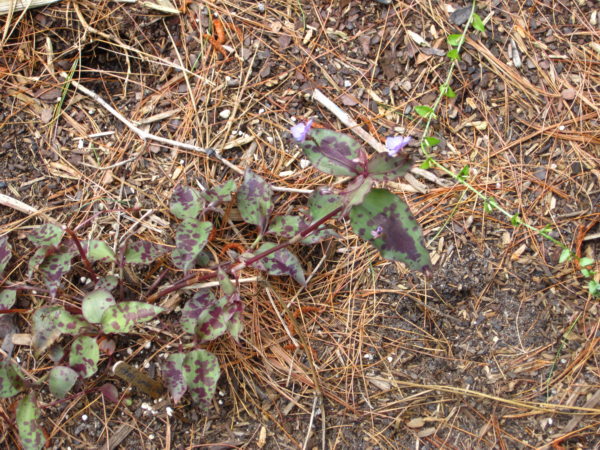
Tiantia pringlei – Spotted Wandering Jew
I got this one through one of Laura Bradley’s plant swap events. As it turns out this guy is a definite relative of widow’s tears and the house plant called wandering Jew. The grouping is also known as the Day flower family because each flower lasts for roughly a day. As a hardy perennial I don’t mind it’s exotic foliage and sporadic blooms but time will tell if it misbehaves as widow’s tears tends to do.

Penstemon Barbatus – Beardtongue
A year later and these hot pink beardtongues continue onward alongside the hybrid yuccas in the little corner garden. Many of their comrades didn’t make it but these three persis ant are now getting black magic treatments for their troubles.


Yucca filimentosa – Spanish Bayonet
Although I’ve said that the name “Yucca” was the most pat name for a species ever their flowers are kind of nice and oddly smell like soap too. This plant receives full sun now that the Carolina cherry is gone and is blooming harder than ever before.

But enough of the garden’s splendor because as of this writing I am happy to say that the test gardens can be toured in two weeks or starting with the second week of June. It is also likely that the gardens will be a part of the upcoming Sustainable Neighbors Garden tour so you all out there get a chance to see what I’m talking about at the market and see some of the process that gets my plants on that table for sale. I might add it is memorial day week end and I’ll be manning a double-header, I’ll have the booth set up for 4th Friday (5-9pm) and I’ll be manning the Fayetteville Farmer’s Market (9am-1pm) and it’s follow up Health Fair (1-3pm) on Saturday. All of this occurs at 325 Franklin Street in downtown Fayetteville in the Fayetteville Transportation museum parking lot.


Southward Skies: A northern guide to southern Gardening
This is the second edition of my book, which was published using data compiled from several years of test garden operations. It’s written to aid gardeners of all skill levels in successful garden methods that are targeted for the south east but had proven to be a valued resource for gardens across the eastern coast. It’s certainly a good gift for that gardener you know or for yourself if you’d like to have a reliable field guide. The book costs $25.00 and we do take checks for this item, you can even have it signed.


Vegetables

2x Eggplant, Casper , 3.5” pot ($3.00)
2x Pepper, Jalapeno, 3.5” pot ($3.00)
2x Pepper, Habenero, 3.5” pot ($3.00)
2x Pepper, Sweet Banana , 3.5” pot ($3.00)
2x Pepper, Pimento, 3.5” pot ($3.00)
2x Pepper, Carolina Wonder, 3.5” pot ($3.00)

2x Tomato, Amana Orange, 3.5” pot ($3.00)
2x Tomato, Brown Berry, 3.5” pot ($3.00)
2x Tomato, Cherokee Purple, 3.5” pot ($3.00)
2x Tomato, Martino’s Roma, 3.5” pot ($3.00)
2x Tomato, Mexico Midget, 3.5” pot ($3.00)
2x Tomato, Rainbow Cherry Mix, 3.5” pot ($3.00)
2x Tomato, Red & Yellow Currant, 3.5” pot ($3.00)
2x Tomato, Reisotomate, 3.5” pot ($3.00)
2x Tomato, San Marzano, 3.5” pot ($3.00)
2x Tomato, Underground Rail Road, 3.5” pot ($3.00)

Fruits
6x Strawberry- Ozark Beauty, 3.5” pot ($3.00)

Herbs
4x Basil, Sweet, 3.5” pot ($3.00)
2x Basil, Thai, 3.5” pot ($3.00)
2x Basil, Cinnamon, 3.5” pot ($3.00)
2x Basil, Red Rubin
2x Bee Balm, Lambada, 3.5” pot ($3.00)
2x Chives, Common, 3.5” pot ($3.00)
2x Fennel, Black, 3.5” pot ($3.00)
2x Mint, Chocolate, 3.5” pot ($3.00)
2x Lavender-Cotton-Green, 3.5” pot ($3.00)
3x Marjoram, 3.5” pot ($3.00)
3x Oregano, 3.5” pot ($3.00)
2x Parsley, Italian, 3.5” pot ($3.00)
2x Sage, 3.5” pot ($3.00)
2x Tansy, 3.5” pot ($3.00)

Coming Soon:
Black Hungarian Pepper
Striped Togo Eggplant
Louisiana Long Green Eggplant
Triple Crop Tomato
Passion Vine

And this brings to an close a holiday weekend edition of Lost In the Farmer’s Market. Despite the threat of thunder showers at 2am on Sunday morning through 4 am there is supposed to be a rather impressive meteor shower, and if it does rain well you won’t have to work all that hard to keep ‘em growing.  By the way friends don’t let friends have squirrels as pets, why do I say this, the tree rates destroyed most of the early black egg eggplant crop; ‘nuff said!

Friday, December 13, 2013

Decembers um....what have you!


Season’s Greetings,

Welcome to the second holiday episode of Lost in the Farmers Market or LITFM for short. Today we have a merry cavalcade of gardening delights, as noted last week the topic this week is the most festive plants that almost anyone can grow. That’s right just two weeks away from the big day of merriment we are talking Euphorbias, that plant species typified by the Poinsettias. Little did you all know it is a diverse and interesting family of which we have some interesting examples here at the test gardens kept as house plants. But Before I get into the topic of the day I must first talk about the weather and the precipitation report. This week as of Wednesday, we had 0.9” of rain spread across two days (Monday and Tuesday) and in between we had at least two frosting events. This is part of the major system that has caused a lot of trouble in the Midwest and Northwest. For our purposes it only gave rain which ensured a lot of crops were sufficiently toughened to handle the cold. We’re not out of the woods yet as far as cold is concerned as winter seems determined to make things difficult this year. Stay tuned for further precipitation information and remember one thing; just because its winter does not mean your cold seasonal crops are stopping their growth light fertilizer doses can go a long way to helping them establish stronger root systems.


Euphorbia pulcherrima - Poinsettia
Of course what is a discussion of the Euphorbia family without a brief overview of its most well-known member the Poinsettia. For those who haven’t studied this plant in any detail the history of the poinsettia is a bit tragic. The first culture to cultivate them was the Aztecs, but unfortunately when the Spanish Conquistadores showed up the destruction of the Aztec culture and recoded history was almost absolute. We still do not to this day know the Aztec name for the poinsettia, but we know it got its modern name from Robert Poinsett who recognized the plant and brought it back to Europe. That said poinsettias are photo-sensitive plants. That is much like chrysanthemums and Christmas/Easter Cactus they require certain lighting conditions to bloom. More so Poinsettias blooms aren’t what you think they are. The colored ‘petals’ are actually bracts or specially adapted leaves that simulate the effects of petals while still photosynthesizing. The little yellow things at the center of these ‘blooms’ are the actual flowers which are well…not so pretty. Most if not all euphorbias bloom this way and it’s a very specific biological adaptation.  As house plants it’s not hard to keep a poinsettia alive after the holidays, you just have to treat it as though it’s a regular house plant, and water enough keep the soil moist but not too much. Keep it in a bright but warm area for winter and then once the danger of frost is passed you can put it out as with the other temporary outdoor house plants.


Euphorbia milli ‘Fireworks’ – ‘Fireworks’ Crown of thorns

Next in line is the Crown of thorns a Euphorbia that is named due to its blooms. The name Crown of Thorns is a biblical reference to the crown of thorns commonly seen upon the head of a crucified Christ. The flowers on crown of thorns are always at the tips of the plants, typically deep blood red and form a red crown like shape. So you have a plant with spines, and what looks like a bloody crown, pretty easy how someone got the idea to name it that. What you don’t know is that crown of thorns is one of the pet-resistant plants due to the large obvious thorns. You treat Crown of Thorns as if it were a cactus which means limited watering and bright light. It can go out for the summer and if enticed to bloom Hummingbirds and butterflies to approve of its copious nectar. While not a plant to put in the ground in our climate it is a good long term house plant. I might add that the variety pictures ‘Fireworks’ also features variegated leaves which in my outlook makes it even more attractive because something is going on all year round. What is not visible is that typically Crown of thorns will have a brown or gray-brown sort of skin on the stems. Fireworks has a red-orange colored stem that almost makes the stems look like they are made of some sort of wax. Sometimes the dimensions of a house plant must extend beyond a bloom and include foliate and texture.

Euphobia tirucali ‘Firesticks’ – ‘Fire sticks’ Pencil Cactus

Move over Scotch Broom and let Euphorbia take over! The pencil cactus is actually a succulent and a member of the Euphorbia family.  Unlike the others in this entry the Pencil cactus is virtually leafless and has a reedy appearance that to a certain degree mimics either grass or Mares tail (equisetum). In the home it’s a accent plant that fills the general role of an accent plant for a bright area that doesn’t need the dangling habits of something like a philodendron. Typically I’d use Pencil cactus in lieu of a Christmas tree and dangle a bit of holiday stuff on it such as miniature bulbs and such and the plant is generally a good sport about it being rigid enough to tolerate my festive shenanigans. I can assure you there will be a picture of this when it’s completed. As a house plant it asks for little though putting it out for the summer causes it to color up in all shades of red, orange and yellow thus earning the name ‘Fire Sticks’.


Euphorbia tithymaloides – Devils Backbone or Redbird Cactus

At one time this species of Euphorbia was called Pedilanthus tithymaloides but recent changes in plant families due to the use of genetic testing have found that the pedilanthus family is in fact genetically Euphorbia. That said the devils backbone is named for its unique colors and the zig-zag pattern of this plant’s stems. The old saying ‘Crooked as the Devil’s Backbone’ comes to mind as the probable origin of the plant’s name. If one considers the brilliant red flowers and the probability that in its native environment the stems and leaves took on a red color at the end of the summer and you have a entomology of a name. As a house plant this euphorbia requires occasional watering and bright sunlight and will tolerate some drafts but not freezing. You would treat this plant the same as any other euphorbia in that you water regularly starting in spring through mid-fall then lay off it watering only when the soil is dry from mid-fall through winter. It can go out for the summer and may benefit from full sun exposure if you can keep up with its watering needs. In India this plant is being researched as a source of petro chemicals to make a plant substitute for petroleum fuel. In addition it has been noted that Devil’s Backbone has promise in agriculture for its ability to tolerate toxic soils.


Euphorbia mammilaris variegata – Indian Corn Cob Plant

“Hey Now! Is that a Euphorbia or are you just happy to see me?”
“No it’s a euphorbia….now get off my lawn you pervert!”

At least this is how I imagine the conversation might go with a sufficiently large Indian Corn Cob plant. This particular member of the Euphorbia family is an oddball for sure. Not only is it slow growing but it’s one of the Euphorbias that most resembles a true cactus and even has ‘spines’ to look the part. What you do not know is that the spines are actually modified leaves, and a close inspection will reveal that.  As far as the plants listed today go this is the most intolerant of being wet. It expressly requires periods of dryness between waterings and tends to get root rot at the drop of a hat however; once it gets growing it’s an easier alternative to a true cactus. I might add it has an odd coloration and texture that resembles some sort of albino Indian decorative corn. You can put it out for the summer but it has to come back in for the colder parts of fall and spring and cannot withstand our winters. Supposedly some can get this plant to bloom but I’ll believe it when I see it, and with that said we move on to one little foot note in the test gardens.

Not bad looking, it took three pounds of fruit or about a pound per pound of brew. The initial brewing container has it's liquids (mostly sugar-laced fruit juices). poured off into the container above and the fruit bits, contained in a nylon straining bag are squeezed of  most of their liquid. This creates a sort of fruit-pulp residue after all strained fluids are moved to the fermentation vessel (carboy) above. the residuals are re-hydrated somewhat with hot water and then are added to the worm bin. I call this mutual benefit, the worms get what amounts to compost-candy and well the rest of us get a lovely starting batch of what may be wine in a few weeks.
That’s right folks there is the batch of Ground Cherry Wine underway after the slightly fermented juices were moved to the primary brewing vessel. Despite the addition of green grapes and that the ground cherries were either orange or yellow it comes off an odd color at this stage. As the batch ages the color tends to change and darken. You can expect more information as this late winter-spring beverage continues fermenting. Now of course we move on to the topic of what’s happening at the market this week. As you may know I’ll be present and accounted for despite the poor forecast at the Fayetteville City/Farmer’s Market. The market is located at 325 Franklin Street and typically runs between the hours of 9:00 am and 1:00 pm. The Market is located in the front parking lot of the Fayetteville Transportation Museum. Of course what LITFM post would be complete without a list of what’s coming to market this week?


Southward Skies: A northern guide to southern Gardening

This is the second edition of my book, which was published using data compiled from several years of test garden operations. It’s written to aid gardeners of all skill levels in successful garden methods that are targeted for the south east but had proven to be a valued resource for gardens across the weather coast. It’s certainly a good gift for that gardener you know or for yourself if you’d like to have a reliable field guide. The book costs $25.00 and we do take checks for this item, you can even have it signed.

Black Magic Fertilizer
That’s right you’ve heard about it in trials all summer. This specially formulated liquid fertilizer was made and tested at the test gardens using natural ingredients and no chemicals. The result explosive growth, great harvests and of course no environmental side effects! We’re making batches of this stuff to order, at $6.00 per gallon of fertilizer. You can either order it at the market and pick it up the next week or have it delivered to your home in the Fayetteville area for a delivery charge of an additional $2.00.

Fresh Cut Herbs
Bundles of Fresh Rosemary, short stem
Bundles of Fresh Rosemary, Long Stem
Bagged Fresh Rosemary No stems
Bundles of Fresh Eucalyptus
Small Rosemary Wreath, fresh cut.

Plants
4x Spineless Prickly Pear
6x Morris-Heading Cabbage Collards
3x Georgia Collards
1x Stonehead Cabbage
2x Savoy Cabbage

This wraps up another edition of LITFM, there are two more episodes left in the month and as you may know we’re keeping it to festive topics for the month next week is the last of those topics because in our final update of 2013, we will be publishing the Sky test garden results. I admit that’s a little boring, a post about numbers but I’m sure some of you out there want to see the data.  So expect more house plants next week and as ways keep ‘em growing!

P.S.
While it is true that friends don’t let friends buy Christmas trees, Real friends help bury the bodies.