Showing posts with label Silver Dollar Plant. Show all posts

Thursday, April 3, 2025

Silver Dollar Plant II

 Note from the Author: This is an update on a weed I briefly covered on January 25th 2019, June 14th 2019 and, January 11th 2020.


This image of the Tuberous roots of Silver Dollar Plant, comes from the wikipedia page for the plant.

This specimen has appeared behind my compost bins, I'm not to upset about this.

Take a look at that foliage!

A close up of the four-petal flowers.


Common Name: Silver Dollar Plant


Other Common Names: Canada Lettuce, Canada Wild Lettuce, Wild Lettuce.


Botanical Family: Brassicaceae (The Cabbage Family)


Botanical Latin Name: Lunnaria annua


Description & Habitat: Silver Dollar Plant is typically found in or near former gardens where it has escaped cultivation and while not considered to be invasive it is a non-native introduced herbaceous biennial. The best way to identify this plant is by the flowers in the second year which have the standard four petals common to cabbage family members. The flowers can be purple, lavender, pink or white, though typical plants grown from purchased seed tend to be some shade of purple. The leaves on the flower stalks of this plant are clasping but overall are heart shaped. Leaves lower on the plant are heart shaped but will have a petiole of varying length. All leaves will have a toothed margin though younger first-year plants may have less pronounced teeth in their leaf margins. This plant will produce swollen roots to allow it to survive for more than one year, and all parts of the plant above ground with exception to the flowers are fuzzy. In some publications this plant may be listed as (Lunaria biennis).


When & What to Harvest: In the first year you can harvest the root or the foliage, in the second year the unripe green seed pods, some of the leaves are safe to harvest for food. The fired seedpods can be harvested in the second year for decorations.


Edible Related Plants: Aside from known members of the cabbage family, Black Mustard (Brassica nigra), Wintercress (Barbarea vulgaris), Upland Cress (B. verna), Garlic Mustard (Alliaria petiolata),  Swine Cress (Cardamine hirsuta).


Similar Dangerous Species:  None are known.


Recipe:  

I have not been able to find a specific recipe for this plant for you, but I have used it as an added wild green in my soups or added the foliage in with normal mustard greens to add more kick.


Additional Information: (If applicable)

https://plants.ces.ncsu.edu/plants/lunaria-annua/


Where to get seed or Bare Root Plants:

https://www.botanicalinterests.com/products/honesty-money-plant-seeds?_pos=2&_sid=d45b35172&_ss=r


With all that garden goodness covered this is the part of the blog where I have to advertise for the Fayetteville City Market. Now I know you readers probably don’t much like advertisements, but my booth at the City Market helps to cover the costs of running the test garden and literally maintains the Research & Development budget that is used to bring you the information that has made up the backbone of this blog.  In addition to being able to process card payments we now take CashApp payments so your payment options for my product have tripled. With that said; if you want to get some GMO-free, Organic fruit, herbs, flowers and perennials, come on down to the Fayetteville City Market on 325 Maxwell Street in downtown Fayetteville between the hours of 9:00 am and 1:00 pm on Saturdays. Even in bad weather the market goes on though you might have to look for me under the ‘arches’ of the Transportation Museum’s front entryway.


For those of you wondering what plants are going to be at the market this weekend here is the list.


Spring Garden Plants:

Swiss Chard, Red

Tomato, Lemon Boy

Tomato, Sungold

Tomato, Yellow Cherry

Tomato, Midnight Snack

Tomato, Cherokee Purple

Pepper, Shishito

Pepper, Ghost

Sorrel, Raspberry Dressing

Mustard, Mizuna

(More TBA!)


Soil Amendment Products:

Carolina Gold, Live Mushroom Compost – 18 Gallon Tote*

Carolina Gold, Live Mushroom Compost – 3 Gallon Bag

Carolina Gold, Live Mushroom Compost – 1 Gallon Bag

Carolina Gold, Enhanced Potting Soil – 1 Gallon Bag


*The 18 gallon tote is by special order only and is delivered to any address within the Fayetteville city area.


How to stay in Contact with Us!

All you need to keep up with all our activities is to have a Nextdoor account and to look for the ‘Sustainable Neighbors of Fayetteville’ group and ask to join! You don’t have to live in Fayetteville to join us! Feel free to ask all your garden questions of our knowledgeable membership and post your cool garden pictures.


Sustainable Neighbors of Fayetteville


Also please take a gander at the YouTube version of this blog:

The Videos: Look Here

>Newest videos (1): All about the Harvest!


Meetings are still going on! Our next (unofficial) meeting is April 5th at the Fayetteville City Market at 325 Franklin Street between 9:00 am and 1:00 pm.


Thursday, August 5, 2021

Computers are wonderful, until they are not.

 Welcome back to another episode of Lost In the Farmers Market, A This post is late by a week. Unfortunately the computer I normally use to write these posts and edit the phots for these blog posts and for the youtube channel is currently out of order. It seems the CPU has gone and I need to find another one. In all honestly I might have to upgrade the motherboard and CPU so I don’t have to keep hunting for parts that are getting a bit scarce. AM3 central processing units aren’t exactly new technology and they’re becoming harder to find in any reasonably quality condition. But thankfully I’ve jerry-rigged a solution to the slight delay and today, although late I have a blog post for you with a ton of garden photographs and info so stay tuned for what is to come.


Here we have a volunteer Cucumber (Cucumis sativus) climbing up a bamboo stake. There are two types of cucumbers that are used in the garden, Bush type and Vine type. The cucumber pictured is a vining type which will climb up just about anything. The bush type has shorter stem internodes and still climbs but doesn’t get as big. Typically varieties like ‘Space master’ are bush type and they’re the best option or containers or limited spaces. They produce cukes as big as the vining types but are better for those who don’t know how the cukes do.  Way back in the mid 2000’s ‘Space master’ was the variety I experimented with to good success.


This pretty flower which looks a bit spindly is Thin-Leaved Coneflower ‘Prairie Glow’ (Rudbeckia triloba). It took a few years to really get it going but these flowers are totally worth it. For anyone who’s read this blog a while you know I have a bias towards coneflowers in general because they are native flowers that are pretty sturdy and reliable. The downside to this type of rudbeckia is that the rabbits seem to like eating it’s foliage a bit much. Thankfully their eating of it stopped once Caliente the cat showed up.


Three years later and in consideration for transplanting this Lily of the Nile (Agapanthus sp.) has bloomed. In our climate these hardy perennials can form dense clumps that resist the intrusion of weeds nicely.


Toad lilies (Tricyrtis formosana ‘Gilt Edge’) have been a long time perennial favorite of mine because they are evergreen in zone 8a and their flowers and foliage resembles Orchids minus all the special care and fuss. The best part is that these beauties spread by stolons so eventually I can give out clumps to friends and they are not invasive.


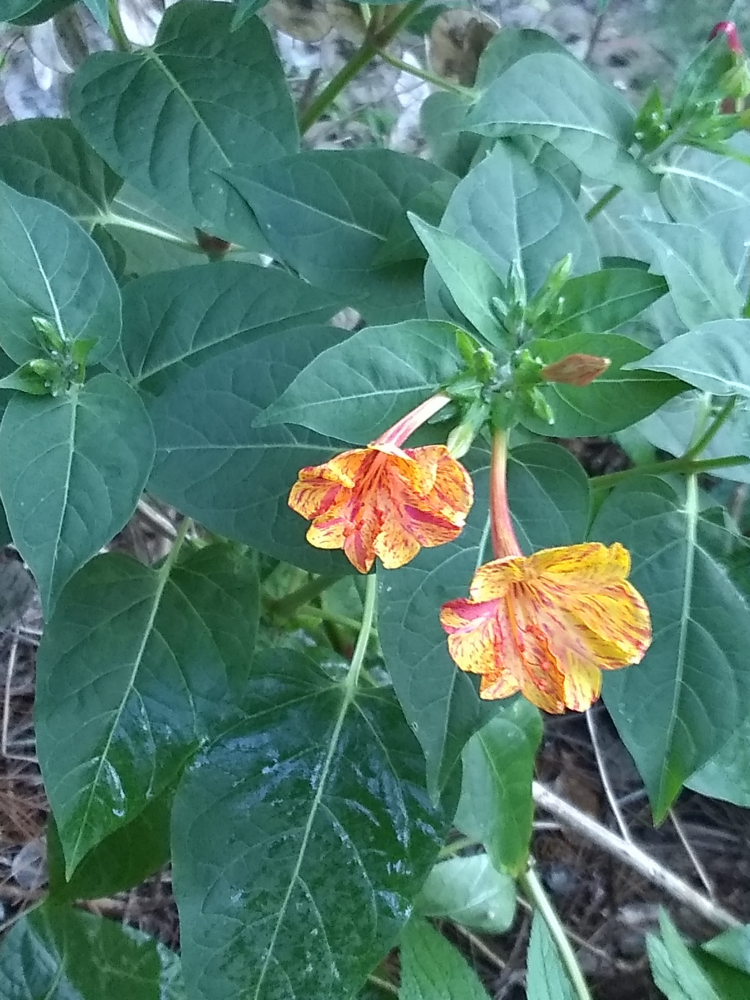
Four o Clocks (Miribilis japapa ‘Broken Colors’) are an old-time garden perennial that I have a special affinity for. They are named because their flowers never open before four pm, and they are the most well-known member of their family. They are considered a tender perennial in zones 7-10, and can form large tuberous roots that resemble rutabagas over time. Their large seeds are easily collected too so it’s easy enough to pass seeds onto neighbors and friends.


More Four O’clocks here, did you know they are also called ‘Marvel-of-Peru? They can have a sweet scent, and are actually native to the Americas. In the background of this picture are the papery seed husks from Silver dollar plant (Lunaria annua).


Inevitably when you have a garden you attract things. This kitten was found taking a nap in the driveway and was super friendly. Unfortunately Caliente wasn’t too kind about having competition for being fluffy and I had to take this kitten to Cumberland County Animal Control hopefully to be adopted by someone soon. Unfortunately FAPS said they were full and could not take her so CCAC was the best option.


Ah, remember that small Castor Bean (Ricinus communis ‘Zanzibar’)? Well this is how big it is now, there is no doubt those leaves are about the size of a pizza pie pan. Lets see how big it gets before the end of the year!


Now here is a life and death moment on the leaf of an Evening-Scented Flowering Tobacco Plant (Nicotiana syvestris). This spider is a Green Lynx Spider (Peucetia viridans) and it is eating what appears to be a Cicada killer (Sphecius speciosus) of some sort. Green Lynx Spiders are numerous in any given garden setting and due to their unique color they are rarely noticed. They pose no threat to humans so it’s best to just observe and leave them alone.


This is an Eastern Tiger Swallowtail butterfly (Papilio glaucus). I get several of these large butterflies in the garden every year; though this is the first time one has stopped to feed on the mint blossoms. I suspect this is a female due to the enlarged abdomen. Typically these butterflies will seek out a member of the Parsley/Carrot family to lay their eggs on. The Resulting caterpillars are those cool looking black and yellow striped ones with the little orange 'antlers' that they poke you with when you disturb them.


While this picture isn’t ideal for identification, this Mantis is probably a Chinese Mantis (Tenodera sinensis). Chinese Mantises were accidentally introduced in 1896 in Mt. Aity Pennsylvania. While they do eat a lot of pest insects they also eat just about anything they can catch which makes them a threat to native insect populations including the Carolina Mantis (Stagomantis Carolina) and the European Mantis (Mantis religeosa). I do not think they are declared an invasive species yet, but they are hard to miss as they are the largest species in the USA as they can get up to five inches long.


Here we have the literal fruit of my labor, three differing types of Fig (Ficus carica). The big green ones are White Ishia, the tan ones in the lower half of the container on the right are Chicago Hardy, and the darker brown figs at the top of the container on the right are Celeste. The scientific humor here is that figs are technically not a fruit, they are called a Syconium. A Syconium is essentially a flower turned inside out, the actual sex bits are those strange filaments inside the fig. Normally a small fig wasp (Agaonidae sp.) does the pollinating. I only know for sure of one species of commercially available Fig that probably has wasp bits in the 'fruit' and that's Calimyrna. Thankfully, Black Mission, Brown Turkey, White Ishcia, Chicago Hardy, Magnolia, Celeste, produce fruit through parthenogenesis. Basically they had a genetic glitch somewhere that made them produce edible fruit without the need for pollination. In short a literal virgin 'birth', and so they were the types that were proliferated by humans because without the need for a wasp, they could go wherever the wasps were not and provide food in exchange for better care. So for all you vegans out there sweating if eating figs breaks your lifestyle and diet, most commercial and homegrown figs are safe.


At last, we have the Botanical Test Garden’s Mascot Caliente the Cat assaulting some weeds. Really those weeds had it coming for growing so aggressively!


Here are the latest YouTube videos for your garden entertainment:


Yucca: Still gonna git you!

https://www.youtube.com/watch?v=UVo38cxaSkM


Ruellia; Ruellia DeVille….wasn’t she in that movie about the dogs?

https://www.youtube.com/watch?v=aImcuHhW5Wo


Coleus; Not Coal Industry Approved.

https://www.youtube.com/watch?v=8cB91RjUVAg


With all that garden goodness covered this is the part of the blog where I have to advertise for the Fayetteville City Market. Now I know you readers probably don’t much like advertisements, but by booth at the City Market helps to cover the costs of running the test garden and literally maintains the Research & Development budget that is used to bring you the information that has made up the backbone of this blog. Also, as of the start of 2019, my booth can now process credit or debit cards thanks to the acquisition of s a Square reader so your payment options have doubled. With that said, if you want to get some GMO-free, Organic fruit, herbs, flowers and perennials, come on down to the Fayetteville City Market on 325 Maxwell Street in downtown Fayetteville between the Hours of 9:00 am and 1:00 pm on Saturdays. Even in bad weather the market goes on though you might have to look for me under the ‘arches’ of the Transportation Museum’s front entryway.


It's Tomato and Cuke Season!


Fresh Food:

Figs, 1 Pound ($8.00)

Tomatoes: 2 for $1.00

Cucumbers: 2 for $1.00


Summer Veggies:

Pepper, 6” pot: Scotch Bonnet ($5.00), Cayenne ($5.00)

Pepper, 5” pot: Assorted ($4.00)


Herbs: ($3.00 each)

Basil, Emerald Tower, Dolche Fresca, Rutgers DMR Devotion ($3.00 each or 2 for 5)

Comfrey ($4.00)

Oregano

Thyme


Ornamental Stuff: ($3.00 each)

Marigold 'Antigua Yellow', 'Durango Red', 'Tangerine', 'Hero Bee' ($3.00 each or 2 for 5)

Coneflower, ‘Artisan Soft Orange’, ‘Artisan Ombre Red’ ($4.00)


Coming Soon:

Milkweed, Milkmaid White ($4.00, more available soon)


How to stay in Contact with Us!


Our group’s online presence has migrated to Nextdoor.com. All you need to keep up with all our activities is to have a Nextdoor account and to look for the ‘Sustainable Neighbors of Fayetteville’ group and ask to join! You don’t have to live in Fayetteville to join us! Feel free to ask all your garden questions of our knowledgeable membership and post your cool garden pictures.


https://nextdoor.com/g/ybvdm226x/?is=nav_bar


Meetings are back on track folks! We now meet at LeClairs General Store on the First and third Thursday of every month. Our next meeting is on August 5th between 5:30pm and 7:00pm. We are in the back room so come on in and join us for a fun garden chat.


If the two above methods do not work you can always contact me through this blog, PM me through Nextdoor.com and or visit the Fayetteville City Market. This brings to a close the sixteenth LITFM post of 2021; stay tuned the next episode which should be posted on or around the 13th of August. There will be more garden updates and other cool stuff.