Tuesday, March 10, 2015

DST Anyone? No? Me neither!


Welcome back to another episode of Lost In The Farmer’s Market,  As you may well know daylight savings time went into effect at 2:00am on Sunday and it is a source of considerable irritation to pretty much everyone. What you don’t know is that it is a myth that it helped farmers use more daylight to perform their tasks. This myth comes from the idea that by getting up earlier somehow you’re getting extra daytime when in fact the number of hours in a given day is give or take the same with adjustments for winter/summer seasons. It’s clearly as much a myth as the old world war two myth that carrots help your eyesight. For note the carrots myth was created by the British military as misinformation to fool the axis powers into not noticing that the British were using radar to find targets. I’ll go out on a limb and say that daylight savings time should be dumped as it literally serves no purpose and any real energy use savings are so tiny that it can’t even be touted as an ecologically useful yearly habit.

But of course this LITFM episode is not about the uselessness of DST, but rather we have a continuing topic of edible weeds, and a rare picture and as if that were not enough we also have a picture of what will be coming to market soon.  But first the main topic, todays subject is a weed that I would imagine everyone who reads this has seen and is very familiar with. It only emerges in the spring and fall once the temperatures tend to top off at about 50-60 degrees and can survive frosts, and winter weather with ease. If you go out and look at any recently disturbed patch of soil or in your planters it is surely growing there.  “Ok so what is this edible weed?” you no doubt want to ask. Well look below for a example


Stellaria media – Common Chickweed
This common garden plant is considered an annual, as it only persists in the cold season but falls apart rapidly during the warm seasons.  There are a few species of chickweed out there with varied edibility standards so this information only pertains to common chickweed.  Common chickweed can be eaten simply by picking the small leaves for use in salad in any amount. The foliage is mild in taste and can be used to effectively counter-balance more pungent leaf greens.  As a pot herb, you would want to cook this one more gently then something like spinach, usually 2-5 minutes at a full boil will suffice and common flavoring additives it needs are butter, a bit of your preferred spices and salt and some chopped onion. Fortunately chickweed has no known poisonous lookalikes, and the entire grouping of true chickweed plants. For note the chickweeds are in the Caryophyllaceae family which is best known for its most famous species the Carnations.


Asarum virginicum - Heartleaf Wild Ginger
This leads to the current photograph of note the flower pictured above is from a perennial cutting of a Wild Ginger plant. Wild gingers are a true wild flower that you plant in a partial-to almost full shade area with decent moisture and forget about. But before you say it, it is not the flower that makes this species special but the evergreen variegated leaves. The leaves are an intense deep green with a silvery-white heart-shaped variegation. Overall a group of these plants forms a nice ground cover that is both exotic looking and well-behaved. It should be said that the wild gingers resemble hardy cyclamen until the bloom and for several months I had the pictures specimen mislabeled until it bloomed just this week. I know the bloom isn’t exactly a show-stopper but it is interesting, and it serves as a biology lesson because you have to ask just what sort of pollinator this flower is intended to attract. My bet is on a beetle or ants as the flowers are very low to the ground and may resemble carrion.

 I get that the angle of this shot is odd but you can see all the current spring crops at once.
We at LITFM are pleased to announce the first spring crops for the market; some of them will be familiar to you, Parris Island Cos Romaine Lettuce, Rouge D’hiver Romaine, Lacinato/Dinosaur Kale, Rosso Di Chioggia Radicchio and, Northern Lights Swiss Chard. In the background you can see the seed starting kits and in them is some good stuff, exotic salad greens and snow peas so sit tight, more of the good stuff is yet to come. Barring bad weather this weekend I plan to bring some of the above listed cold-season crops to market due to your requests. For note most of them were moved up from the cell packs I started them in roughly a week ago.
For those who have not heard, the Fayetteville City Market occurs on Saturdays between the hours of 9:00 AM and 1:00 PM, in all but the absolute worst weather. The market is located on 325 Franklin Street in the front and rear parking lot of the Fayetteville Transportation Museum. The market is a year-round affair unofficially but our official season kicks off in April so stay tuned for the announcement of the market’s big spring celebration. Either way we’re open for business.

Thursday, March 5, 2015

And Yet More Winter!


Welcome back to another episode of Lost In The Farmer’s Market. We’ve got a good episode in store covering a topic that becomes more critical in winter months than others so sit tight today we will be talking about weeds. Before I get into that I do have to post a word to the wise for all you gardeners out there, the weather has made cabin fever a little worse this year than in others and so those shiny seed catalogs keep showing up.  The issue with this is that a gardener is highly tempted to buy more than he or she can realistically handle or buy things above your skill level. It’s always wise to show some restraint when dealing with ordering things from the catalogs because you may not know how they actually perform in your area or there may be cultivation tips for growing that you are currently unaware of.  For instance, growing milkweed or say lupines is far harder then you realize and without a good reference or someone to consult who’s done it before you may suffer a lot of avoidable disappointment. I bring this point up because winter is coming to its end even if it is tossing storms as though it were having a tantrum.  Needless to say there are three things you should ask yourself before ordering anything from a seed catalog.

1.      Have I grown this before?
If your answer is no; be careful - seed packets and their catalog listings might not tell you the special growing instructions for some species.

2.      Do I know how well this handles my local climate?
This can help you avoid invasive species, even mint can become invasive in the right spot.

3.      Will it need special care?
Orchids look wonderful, but can be difficult if you don’t know what to do. Some seed requires scarification, stratification, acid treatments or may take up to two years to germinate.

There is one other point to be made here, the garden catalog’s exist to sell you things, so they tell you just enough to get you started but not enough to really educate you in what you are getting into. So be careful before you order and try to start with a set budget before you start compiling a seed list and in theory you should be able to keep that winter garden mania under control.

So with the forst bit covered let’s talk about today’s main topic. If you’re a regular reader you know that I define weeds optimistically as the following.

“Any plant whose chief virtue has not yet been noticed.”

That may annoy some of you ‘lawn care professionals’ out there and the herbicide industry but no one cares what you think anyway. The fact is that weeds can be beneficial in a number of horticultural roles such as telling us things about the soil conditions, or the amount of sun or lack thereof that an area receives. Some indicate how high the water table is or where water often pools others indicate how long ago the native environment was disturbed by construction or human activity in general. Others still provide food sources that often go ignored because we don’t recognize them as such. Today’s such plant calls in that latter grouping. Today I am talking about Rattlesnake Weed.

Florida Betony/ Rattlesnake Weed - Stachys floridana
The above picture shows a cultivated specimen of this species. In the garden rattlesnake weed is considered a weed because it is a cool season perennial that spreads rapidly during a time period in which most cultivated plants are winding down. This spread gives the appearance of it being invasive when in fact it is a native species. It is thought that Rattlesnake Weed was contained to Florida up until the 1940’s to 1950’s when it got outside of the borders of Florida most likely though nursery plant stock.

A close up of the leaves, notice the similarity to the herb Betony?
What makes Rattlesnake weed interesting is that it reproduces through its tuberous root stock; this is asexual reproduction so it can spread without a pollinator which allows it to colonize large areas. It responds to even the faintest traces of fertilizer and can handle all but the wettest of soils with ease. The plant gets its name from the shape of its tubers which resemble the tails of rattlesnakes. The tubers are often white with some tinges of green where they were exposed to sunlight and tend to be about ½” wide and on average 1-4” long, some specimens have been recorded as growing up to 8” long. New tubers are formed in late spring as the soil temperatures rise. Rattlesnake Weed typically goes dormant or semi-dormant for the hottest summer months. It will tolerate full sun if ample moisture is present but seems to prefer partial shade. Although I have not personally witnessed it all references to this plant indicate that it has trumpet shaped flowers that may be white or pink and may have purple spots, it’s suggested that blooming occurs in late spring. There is no information on what the germination requirements are for seed from Rattlesnake Weed.

With all that said here is why it is interesting, Rattlesnake Weed is in the Stachys family which means it is related to Lamb’s Ear Stachys Byzantina, Betony Stachys Officinalis, Chinese Artichoke Stachys affinis and, Hedge Nettle Stachys sylvatica. All members of the family are called woundwort because some aspect of their bio-chemical composition aids in the healing of wounds. When they do bloom members of this family are very attractive to bumblebees and honey bees so they serve as a nectar source. I might add that all Stachys are in the Lamiaciae family group making them relatives to mint which explains rattlesnake weed’s habits. Ironically it also makes lamb’s ear the most un-mint of the group, apparently the “square” in a family or wild and crazy herbs.

Now why eat rattlesnake weed? Well the tubers contain a sweetening compound called Stachylos which is not completely digestible which may have some benefit to diabetics. It is also suggested, though I cannot absolutely verify it, that the special sugar compound in rattlesnake weed promotes friendly gut microbes and inhibits the growth of certain types of infection. For food purposes the leaves can supposedly be used in place of tobacco for antioxidant purposes. The tubers can be eaten raw albeit sliced thin in salads and are said to have the texture of radish, with a sort of cauliflower-jicama flavor. It’s referenced in several texts that the roots can be used to supplement potatoes, Jerusalem artichokes, or fried to a crispy texture in a stir fry with onions.

Personally as you see I have a lab specimen I’m cultivating, I found it makes an interesting house plant. Rattlesnake weed is seemingly pest free, vigorous as any aggressive philodendron and as long as I keep it in its own pot with a big saucer beneath and it’s well-behaved. Not bad for a ‘weed’ really, it’s one of the few things where I could see palpable growth on a weekly basis. Who knows it may have a future as a pollution-proofed food source or something. Either way considering the rangy looking plant corn came from; with cultivation perhaps betony will put potatoes out of business in the future too.

That covers our topic for this week, next week we’ll be talking about another weed you can eat that is incredibly common this time of year in your yard. Check back with us next week and if you have any questions about the content you can visit us at the Fayetteville City Market this at 325 Franklin Street this Saturday between the hours of 9:00 AM to 1:00PM.

Tuesday, February 24, 2015

Baby its cold outside...


Welcome back to another episode of Lost In The Farmer’s Market where the winter doldrums may have slowed things down but we’re still making progress towards the next big thing. This week we have some interesting news in the form of a winter project that may surprise some of you out there. In agriculture we have two primary camps the Organic/GMO-Free group and the Conventional group and to that end there is a variety of products out there for both. It is not my intention to turn this article into a form of ‘us versus them’ diatribe, but rather to talk about the next logical step in the means to prove that those of us in the non-GMO/Organic crowd can do exactly the same thing as the conventional folks minus the petrochemicals and so on.

So for my winter project I set out to build a cloning system with the objective that it be as effective as a compact model that can be purchased through a commercial source. The two examples I evaluated as the basis for what I built can be found at the following two links.


The price increment on these models would be prohibitive for the home grower and since one might typically use a thin solution of plant hormones to encourage root growth well the organic label is then in question. Plant hormones used to promote rooting have to be extracted from a plant chemically, purified then suspended in a solution of some sort, or flat synthesized in a lab somewhere. The powdered rooting hormone found at every garden center is basically a thin rooting hormone held in pure talcum powder, whereas the commercial grade rooting hormones are in liquid suspension. I should mention here that a standard jar of powdered rooting hormone cannot be used with ‘wet’ propagation methods and costs around $6.00 for a small jar with a few ounces of powder that may last a home grower a few years. When you get into the liquid rooting hormones such as Dip ‘n Grow, two ounces can cost up to $15.00, and the procedure for use is very precise. 

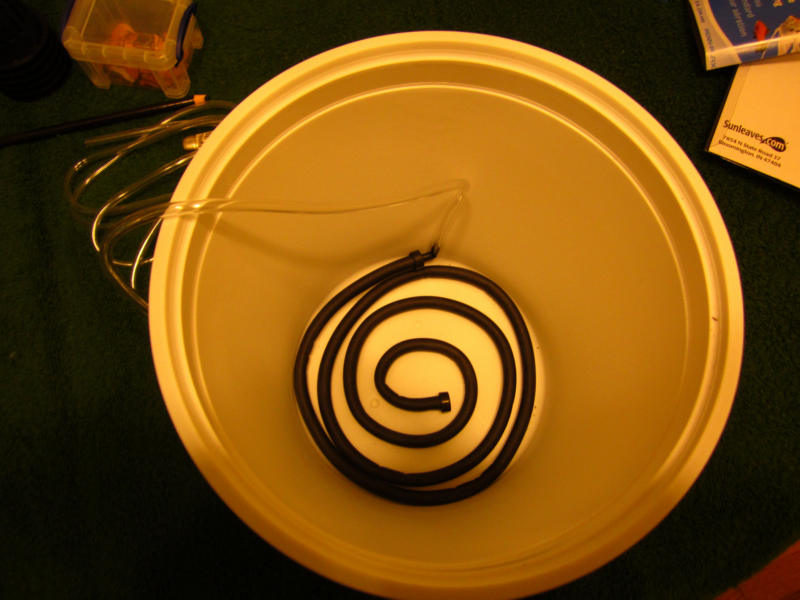
To get around this, we at LITFM constructed a Hydro-cloning system from components that one could buy off the shelf at a garden center, supermarket and pet store. As you can see in the below picture our cloner is built out of a 1 gallon plastic food grade container with lid, a 44 Gallon per hour air pump, a coil of flexible air diffuser tubing, 3’ of 3/16th fish tank airline tubing and, six net pots and six neoprene plugs.  In terms of tools I only needed a small sharp knife and a wax pencil. Estimated construction time was about 30 minutes


All the parts you need, total cost is about $30.00.
The first step was to shape the air diffuser coil in the bottom of the reservoir, you would want it to follow the outer edge, and coil evenly inward to spread the diffusion effect so the water in the reservoir has no stagnant spots. I chose the flexible one because it can take the shape of any container and be adjusted on the fly if needed. A large circular air stone could also do the same job.

It looks like there’s too much air diffuser but the thing wont bubble over so it works.
The next step is to cut the hole in the lid for your airline to go through so you can position it to your liking. I did not completely cut it out initially so while I did step three it wasn’t in the way.


Yes, this food grade container was a leftover from a holiday party…you can guess what was in it.
Using one of the 2” net pots I used the wax pencil to mark where I cut holes in the lid so the net pots could be placed through the lid to dip into the reservoir.

Theoretically the net pots could be any size you want, I chose 2” for space-saving purposes.
As you can see the cutting is done in this case with a small pocket knife, but a razor or exacto knife would work equally well. Just remember to take your time and be safe while doing this.

This was the slow part of the project.


Presto! The perfect seating for the 2” net pots.
Cutting out the holes for the net pots means cutting inside the marked line so the pots sit on top of the lid and do not fall in.

It is compact enough to sit on a dining room table and quietly do its job.
You can see all six net pots seated properly, and next the little flap near the airline is cut and this completes the body of the Hydro-cloning system. This is a simple little system that produces six clones at a time and cannot have its water go stagnant. The container is food-grade so there will be no worry of the plastic leaching anything into the water, and the best part is that even if out in the lab its mosquito proof because of the diffuser.
Um, for note folks this is NOT a Skittles commercial!
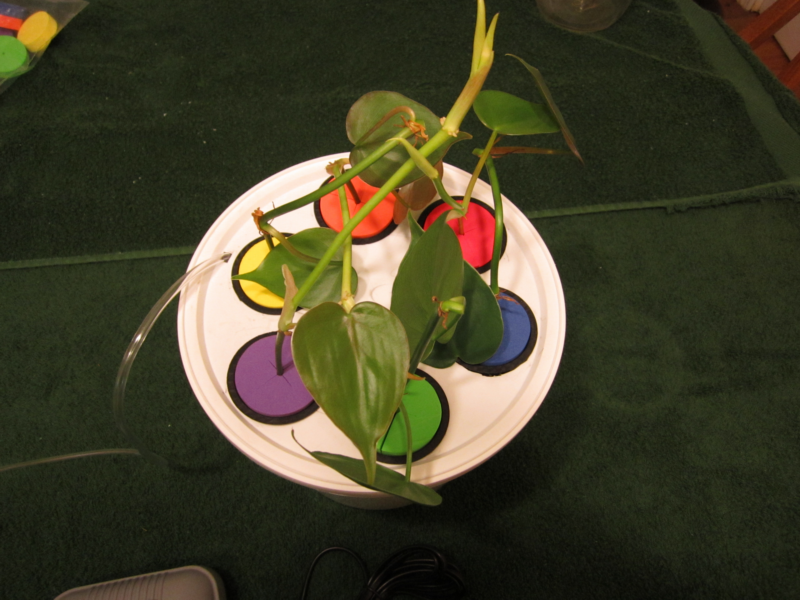
The last step was to insert the Neoprene cutting holders, with trimmed cuttings in them and to turn the system on. The air pump buzzes but is barely noticeable the gentle bubble of the diffuser putting tiny air bubbles through the water in the reservoir is more noticeable. I might add at this stage I added a gallon of distilled water (personal preference on this part) and well you can see the final product in the next image.
Yup here’s what it looks like in operation.

The first trial plant is a Heart Leaf Philodendron - Philodendron scandens which by philodendron standards is slower to root in water but far more tolerant of abuse then your regular philodendron. The thing is I know no matter what it will root and having grown and sold this species before the time frame for it.  The plan is to run five trials with the system using an increasingly difficult set of cuttings. You can bet the results will be right here when available.

So there you have it another wintery episode of LITFM. This early post comes on the heels of our second frozen precipitation event of the year which means more delays in production schedule. It sort of figures that I get a LITFM project done on time and it snows which may prevent next week’s topic. Either way check us out next week for more wintery mayhem. Don’t forget the Fayetteville City Market is still going on Saturdays between 9:00am and 1:00pm in downtown Fayetteville on 325 Franklin Street.

Thank you for reading!

Wednesday, February 18, 2015

In Winter's Grasp

 As always in February there is some sort of winter precipitation event and this year we got to the third week before we got hit. These pansies will recover, but while partially encased in ice they serve as a metaphor for that sort of crazy impatience gardeners get in longing for the spring.


Some azaleas were not so fortunate just a few feet away, encased in ice I cannot count on this area not being damaged.

In a repeat of last yer icicles form a neat trim on the gutter of the rear of the house.

The white pines are used to being treated harshly by old man winter, you could say they relish it as though it were a sick pleasure.

Figs were encased also and only the spring will determine if they survive this brief encounter.

Looking like some crystalline spider, or a mass of strange coaxial cables this muscadine grape stands out as a delicately frozen ice sculpture.

I wonder, will this juvenile long leaf pine survive being frozen solid and  flattened to the ground due to the weight of the ice that suffocates it?

What is this? I don't even!

As much as the white pine can scoff at winter's abuse someone had to take the retaliation, here one pine has shed a large number of branches on one facing, a tragedy of sorts.

The heavenly bamboo did alright.

That's all for this week, LITFM will be back next week with a serious indoor project in progress that all of you out there might be very interested in. Check back soon!