Showing posts with label Rain. Show all posts

Thursday, October 29, 2020

Strange Days Indeed!

 Welcome back to another episode of Lost In the Farmers Market, and although this post is just a full week late there is a good reason for that. The fall tour was on Sunday the 18th and the preparation work for it was pretty serious as were  demands for additional hours by my day job. Additionally, in that same time period I posted my 50th garden video to Youtube and was working on where to go from, there and how to announce what the channel would be doing in 2021. You can see my garden videos at the link below:

https://www.youtube.com/user/curacaovexxor/videos

Well anyway, I figured out what direction to take the garden videos, and also figured out what needed to go on this blog and am still working like a dog at my day job. The tour went well but the garden wasn’t as ready as I would have liked but they say an artist is never happy with their work or something like that.  So as you all can tell it’s both Autumn and Hurricane season which makes for oddly bizarre weather in the southeast, one day it’s like summer, then it’s raining and humid as hell, then it’s raining and cold and then cold at night only and the randomness just goes on and on. What some of you readers out there might not know is that you can plant your cold-season crops as late as mid-November. Also if you have a large enough pot your crops don’t expressly have to go in the ground so there are alternative options for planting something pretty, for food or a mixture of both. Our first official frost date is December 1st so we have an entire month to get down with the gardening. Typically the frost date can vary by plus or minus a week but that’s still most of November. In light of this I am planning an expansion of the vegetable patch and that will be covered in the next post. In mirror of the cold-season crops you can plant now, my Youtube channel is covering cold-season crops exclusively so you know what you are getting into. The next six videos will cover Kohlrabi, Red Cabbage, Swiss Chard, Lettuce, Japanese Mustard, and Mustard greens respectively. There will be two episodes posted per week so all of your garden info will be ready to go. But enough of this talk of videos and garden stuffs, how about some garden photographs!


This year I decided that my growing tray winter annuals would be Snapdragons (Antirrhinum majus), these are the pink ones. I also planted red ones and white ones all of the Liberty series, since Pansies and Violas really don’t cover the pinks or the richest of reds these potted annuals will fill the bill. Plus only bumblebees can get at their nectar which encourages them to stick around.
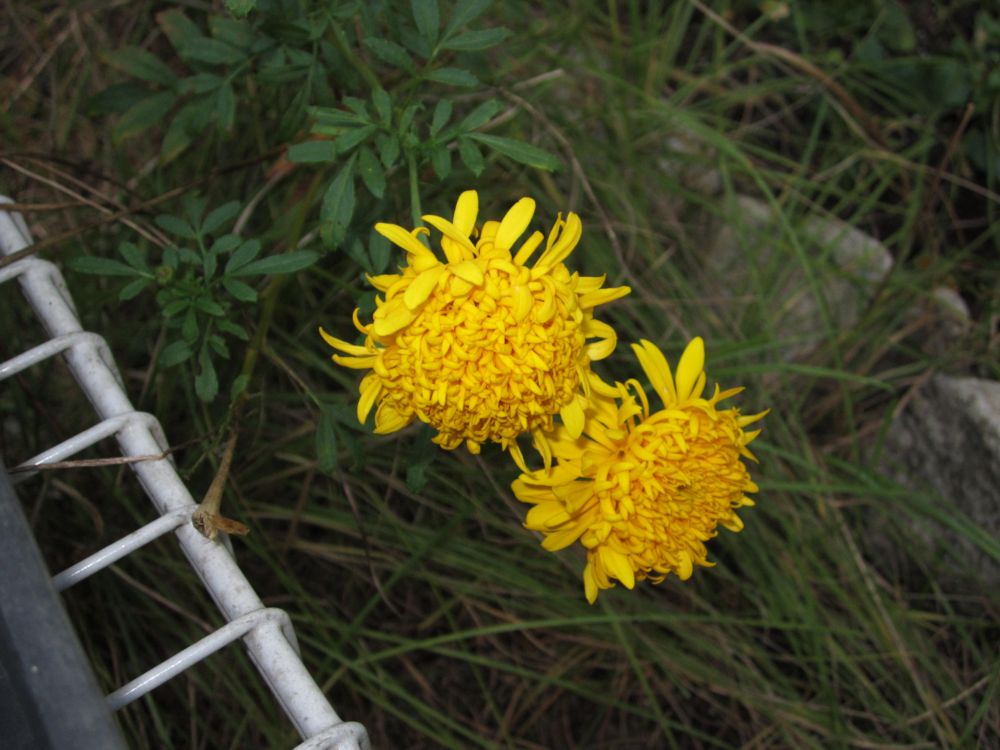


Here is a picture of the last of the Giant Mission Marigolds (Tagetes erecta), but unlike prior pictures a close up of the fabulous chrysanthemum flower heads. This right here and the fact they get three feet tall is why I bought the slightly overpriced seed. If the marigolds had a king, this would certainly be it.


Canna Lilies (Canna generalis) are a common sight in the south, though normally they are of the red-blooming variety. I originally got these specimens from a relative and they persevered in a less than ideal spot until they were moved into the crescent bed where they are recovering and expanding rather nicely. I actually thought they were orange or red, but the Canna which bloomed last year proved me wrong.


I know I posted this picture in the last post, but I’ve managed to get a fair amount of seed from these morning glories (Ipomoea purpurea). If they breed true the red-yellow combo might be something big and very cool, you can expect more updates on this in the future.


With all that garden goodness covered this is the part of the blog where I have to advertise for the Fayetteville City Market. Now I know you readers probably don’t much like advertisements, but by booth at the City Market helps to cover the costs of running the test garden and literally maintains the Research & Development budget that is used to bring you the information that has made up the backbone of this blog. Also, as of the start of 2019, my booth can now process credit or debit cards thanks to the acquisition of s a Square reader so your payment options have doubled. With that said, if you want to get some GMO-free, Organic vegetables, herbs and fruiting shrubs come on down to the Fayetteville City Market on 325 Maxwell Street in downtown Fayetteville between the Hours of 9:00 am and 1:00 pm on Saturdays. Even in bad weather the market goes on though you might have to look for me under the ‘arches’ of the Transportation Museum’s front entryway.

Fresh Produce:*
Soup Kit: Parsnip: $6.00
Soup Kit: Turnip: $6.00

Food Plants: (3” Peat Pots)
Arugula: $3.00
Cabbage, Ruby Perfection: $3.00
Celery, Tango: $3.00
Collards, Carolina: $3.00
Kale, Lace: $3.00
Kale, Lacinato: $3.00
Kale, Marrow Stem: $3.00
Kale, Red Russian: $3.00
Kale, Scotch Blue Curled: $3.00
Kale, Winterbor: $3.00
Kohlrabi, Cossack: $3.00
Swiss Chard, Mixed: $3.00
Spinach, Avon: $3.00


Herbs: (3” Peat Pots)
Black Fennel: $3.00

 
Coming Soon:
Garlic Bulbs
Ginger
Seasoning Packets

*You can special order a specific vegetable by the pound if you want anything specific that is in the soup kits or any specific herb contained in the seasoning packets. Vegetables are sold by the pound and seasonings are sold by the ounce when sold individually.

We have a new place to share information and work on groovy sustainable stuff!  You can look for Sustainable Neighbors in our own Nextdoor.com group under the name “Sustainable Neighbors of Fayetteville”. You don’t have to live in Fayetteville to join but it is a private group so feel free to request to join us if you are signed up on the Nextdoor.com site.

https://nextdoor.com/g/ybvdm226x/?is=nav_bar


Unfortunately, Covid-19 is still mucking up the works in terms of meeting in person. The good news is that Sustainable Neighbors does have a Discord Server. You can request access through our Meetup.com page or you can request access via our Nextdoor.com group. The meetup.com page is below for anyone looking to join us.

https://www.meetup.com/SustainableNeighbors/

Since our meetings have an open-door policy you don’t need to buy anything or maintain any sort of attendance standard, you can come on in and join the meetings. When this Covid-19 mess calms down we may be able to resume normal in-person meetings. If not, you can always send me questions through this blog or visit the farmer’s market. This brings to a close the twentieth LITFM post of 2020; stay tuned the next episode which should be posted on the 30th of October. There will be more garden updates and other cool stuff.

Sunday, March 3, 2019

As February winds down, March may be a repeat


Welcome back to another episode of Lost in the Farmers Market.  This post which was supposed to appear on the 22nd of February was stalled by bad weather which prevented me from taking pictures in the field. This weird rainy cycle we’re having seems like something that belongs in April, not February, but I suppose this is what climate change looks like at it’s simplest. So, to start off I have some pictures from the test gardens that will get you in a mood to prepare for spring and of course garden preparations is the topic for this post and MARCH in general.

This daffodil cluster needs to be divided, but is doing ok under the Persimmon tree.

I dont know about all you gardeners who read this blog but my surefire sign that spring is close comes in four forms, the bloom of Daffodils (Narcissus sp.), Forsythia (Forsythia suspensa), three-spine Barberry (Berberis wisleyensis) and, Leather Leaf Mahonia (Mahonia bealei). All three plants bloom in a bright cheery yellow when nothing that colorful is blooming and all of them are aromatic. The Daffodils will bloom without complication in the middle of February and since they now come in a wide variety of colors, you can find a daffodil to suit your fancy. It should be noted that Narcissus are highly poisonous and they are utterly unpalatable to deer and rodents which makes them the ideal protector for non-poisonous bulbs such as tulips. I they are inter-planted the daffodils will protect the tulips from being dug up.

These are the color changing daffodils in the Memorial bed.

 Some daffodils like the one above start yellow, and fade to another color. The daffodil pictured is the 'Thalia' variety and it starts golden-butter yellow and fades to pure white making for a show in spring that cannot be beat.


Three-spine Barberries are a prickly obstacle, but the blooms are worth it.
Three-spine Barberry (Berberis wisleyensis) isn't seen in the landscape much because of most gardener's aversion to the plant's spines which can be up to two inches long. In late February however the plant as seen in the picture is covered in little yellow blooms that smell somewhat like lemons  once they open. This is also a trait of the Leather-Leaf Mahonia I mentioned earlier. The reason the scent is important is that a good garden should not just focus on bright colors, texture and scents are just as important. 

Rabbiteye Blueberries are a southern tradition.

 In the late winter I do get a lot of folks asking if they should cover their blueberries because they are concerned about a frost damaging the flowers and foliage. I always say no because blueberries are very adaptable and if sited well in the landscape can survive things that very few other fruiting shrubs can. Blueberries as a whole are very forgiving and are perhaps the easiest plant you can grow that produces a yearly crop of fruit. I also always recommend Rabbit Eye Blueberries (
Vaccinium virgatum) for our area because they are the native variety. In comparison to something like a Highbush Blueberry (Vaccinium corymbosum) which is better adapted for northern climates and Lowbush Blueberry (Vaccinium angustifulium) which is even more northern and more native farther west by comparison. Problems often arise when nurseries do not clearly label their plants or dont care to sell the right variety for the region. Always ask for the variety you want by it's specific name and check to make sure the scientific name on the tag matches what you want. There is no one-size fits all growing standard for blueberries because each of the three varieties I've listed need something a little different to yield an optimal harvest. 
With all that said, Rabbiteye blueberries are the best type for our region, they can withstand our weird winters, they can handle our flood/drought cycles and they will produce quite well with minimal maintenance and management. In case you are wondering, Rabbit eye blueberries got their name because they produce of the largest blueberries possible, roughly the size of a rabbit's eye.

 
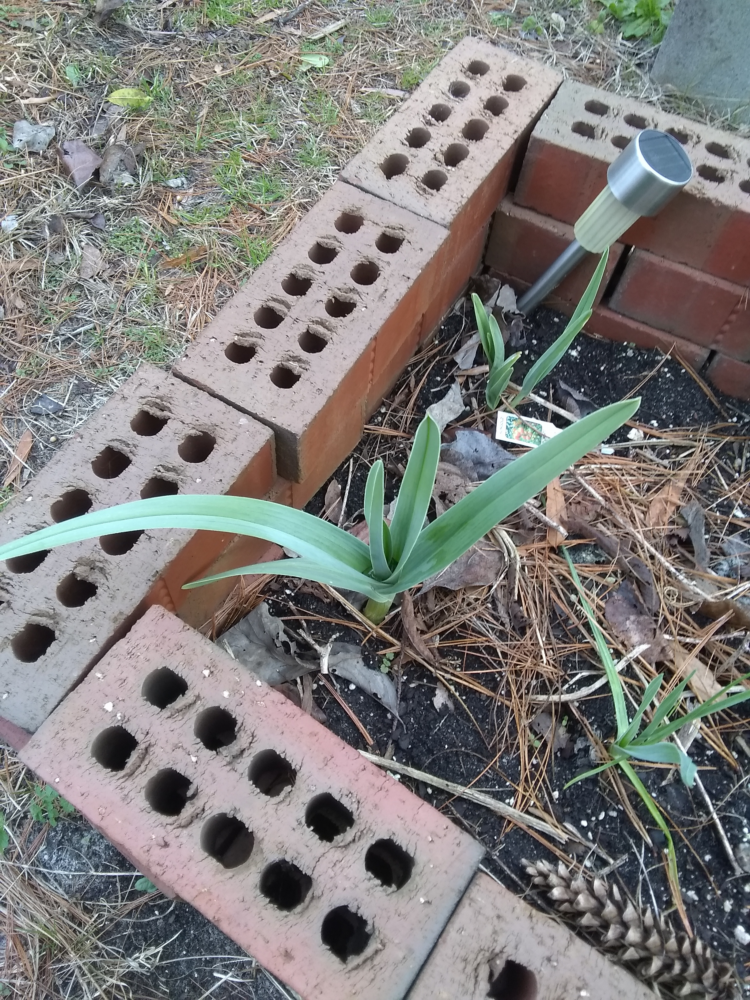
Visitors at the farmer's market have been asking me to post this for a while.
 The above picture is what the greenery of Garlic looks like. It looks oddly like a Leek doesn't it? Well this i because Garlic (Allium sativum)  and Leeks (Allium ampelopasm 'Leek Group') are both in the Onion family, so are Chives (A. schoenoprasm), Shallots (A. cepa var. aggregatum), Scallions (A. cepa), Egyptian Onions (A. x proliferum) and, Ramps (A. tricocum).  The onion family has a lot of members and there is pretty much a species native to every continent except perhaps Antarctica and the extreme north.  Garlic is fairly easy to grow because it's not space intensive and can be planted around faster crops with virtually no competition. Typically you grow a crop of garlic by amending the planned planting site with bonemeal or something like Azomite and then  planting individual garlic cloves spaced about 4-6" in a row. You should increase or decrease the amount of space away from other row crops based on their crowing habits accordingly to increase your overall success rate with garlic. Planting should occur at the beginning of September with garlic cloves that have begun to sprout if weather permits, otherwise un-sprouted garlic cloves can be planted at any time during September. Beyond keeping the weeds down no other maintenance is needed. Harvesting time is typically the following April, though if the garlic bulbs attempt to bloom you have to remove the flower before it blooms. The good news is the flower and it's stalk are 100% edible and are a great ingredient to add to a pot of broccoli rabe.

This is not at all garden related but silly non-the-less.
 Ok, this is a catalog I get and the image on the cover was too silly not to share. Duluth trading has some good stuff, but their cover art is always wacky. So apparently I've been doing it wrong for decades, I should stop planning around bad weather. Yup, to stop all this rain we're having I just need to go out and grab a storm cloud by the 'swinging johnson' so the rain stops. Oh and look mildly angry and wear a blue rain jacket thingy.  Yup take that mother nature!

 
This image was snapped during the brief period on Wednesday when the rain had stopped.
 This is the photo of the week, the afternoon skies after the rain stopped for a day or so, what really caught my eye here is how in the lower right the sky is almost green-yellow in contrast to the rest.

When I say we're under the arches and 'rain or shine' I mean it

With all that garden goodness covered this is the part of the blog where I have to advertise for the Fayetteville City Market. Now I know you readers probably don’t much like advertisements, but by booth at the City Market helps to cover the costs of running the test garden and literally maintains the Research & Development budget that is used to bring you the information that has made up the backbone of this blog. With that said, if you want to get some GMO-free, Organic vegetables, herbs and fruiting shrubs come on down to the Fayetteville City Market on 325 Maxwell Street in downtown Fayetteville between the Hours of 9:00 am and 1:00 pm on Saturdays. Even in bad weather the market goes on though you might have to look for me under the ‘arches’ of the Transportation Museum’s front entryway.

Plants & Stuff Available Now:

Soup Kit, Parsnip - $6.00
Soup Kit, Turnip - $6.00
Ginger, 6.0 oz - $2.00
Garlic, Whole bulb - $1.00
Seasoning Pack - $2.00
Lavender Pack - $2.00

Miniature Peace Lily, 4” - $4.00
Gold Dust Bamboo, 4” - $6.00
Flowering Maple, 4” - $3.00
Flowering Maple, 6” - $5.00
Polka-Dot Plant, 4” – $3.00

These days I am generally at Leclair’s General Store once a week, for the weekly Sustainable Neighbors meeting at 5:30pm through 7:00 pm. If you have questions then I will be there to answer your questions. Since our meetings have an open-door policy you don’t need to sign up for anything or join anything, you can come on in ask for us and join the meetings. If not, you can always send me questions through this blog or visit the farmer’s market or pay attention to what Sustainable Neighbors is doing at the link below.

https://www.meetup.com/SustainableNeighbors


This brings to a close the fourth LITFM post of the new year, stay tuned the next episode which should be posted on the 8th of March. The next post will cover late winter garden planning and is the official start of the pre-spring preparation planning series.