Welcome back to another episode of Lost In the Farmers Market, where finally Autumn has arrived and the season begins with cooler temperatures and discussions of a winter garden. Despite what some might tell you here in Zone 8a gardening is a year-round affair. The warm season crops go in in April around Easter, and the Cool –season stuff goes in roughly around September. Some stuff like Collards takes a little longer and thus, we start them in early-mid August if from seed but at the start of September if using plants. Every crop has its nuances that you need to keep an eye on. For instance, if you started seed indoors you need to start sowing things as early as mid-July to August to get the best results for the slower growing cool season crops.
Fortunately we have a great opportunity to get things rolling while the humidity is low and night time temperatures are cool. It is less physically exerting to garden when the weather is cooperative and also the bugs are less aggravating. You should not wait to get those crops in the ground though because the longer you wait the less likely they will have established and the higher chance a frost might wreck everything. Additionally, procrastinating will delay your effective harvest, and that could mess up your culinary plans for Thanksgiving, Christmas or the New Year. A lot of people ask in general if it’s too late or too soon and the simple answer is that it is somewhat complicated. Gardening thankfully is not an exact science with a catch-all answer to all problems or quandaries. Generally speaking, you put warm-season crops like tomatoes and peppers in after Easter in spring, and start planting out the fall crops in late August or September. I personally can say that I have planted out things as late as the end of October and gotten good but delayed results. As long as you don’t wait too long you can still have that cool season low-maintenance veggie garden you have had a craving for.
With all that said, there are a few things you should consider starting from seed versus buying as plants. I typically start Cilantro/Coriander, Radishes, Carrots, and Snow Peas from seed in the garden because it’s so much cheaper and effective to do so. These plants do not benefit from being transplanted and their roots tend to grow quite fast and you really don’t want to disturb that. Generally you don’t want to disturb any plant’s roots if you can help it but with some they seem to experience no real loss in productivity if you do. As a general rule you never want to disturb the roots of anything producing tubers (radishes) or that has a taproot (carrots, fennel). Peas are in this group because they produce a lot of roots fast and can rapidly out grow their containers if the container they were sprouted in is not big enough so it’s better to give them root space right off and let them do their thing. What you start by seed hinges on your spare time that you can apply to maintenance and your gardening skill level. For those of you out there who are wondering; the easiest things to start right now are Snow peas, Carrots, Cilantro and, Radishes. The latter three can have their seed tossed on any patch of dirt that’s been slightly scuffed and is moist. The former needs to be covered in about ¼” of dirt but that’s pretty easy and the seed is large and easy to handle.
Peas are a great way to get young kids involved since they are very noticeable when they germinate and emerge. More difficult and or finicky seeds like Swiss Chard, Cabbage, Cauliflower, Celery, Broccoli, Cauliflower and so on should be started indoors over a heat mat to maintain soil temperatures. Some of these seeds like the celery need to be soaked overnight just to germinate properly.
The key to getting your sown seed to come up uniformly is to gently moisten the soil where you sowed them on a daily basis (assuming no rain) for about two weeks and then as needed once the seedlings are visible. The easiest way to do this is to use something like a rain shower wand attached to a hose or a watering can so the water doesn’t wash out the seed or beat up the seedlings. You should avoid using any sort of fertilizer for about two weeks after the seedlings emerge to avoid burning but, initially use a water-soluble fertilizer at half-strength weekly for three more weeks to really get things going. After that assuming there are no freezing temperatures or rainy weather you can switch to a two-week rotation on fertilizer at normal strength. I would also advise using mulch, but not that wood mulch you can buy at the bLowes or Home Despot, what you want is quality Pine Straw because it does not float, it barely changes color and it discourages digging animals. Also it does not acidify the soil as much as some think and there’s the bonus value of it not attracting termites. Now, with all that said here are some garden photographs.
 | |
| The first step to preparing the warm-season garden for cool season growing is to harvest what you can, which in this case is the carrots, basil, perilla and whatever peppers and cotton are ready. |
 |
| After the bed is weeded and the soil gently moved around a bit with the hard steel rake, the collards are planted with about a foot of distance between them. I add a bit of granulated tobacco fertilizer at this point just to give them a constant boost as they grow. |

The final step is to apply a decent layer of pine straw to keep the weeds down and the critters from messing with the seedlings. I watered it all with the rain wand attachment on my garden hose right after and maintained a once-a-day watering schedule for two weeks with adjustments for rain.
 |
Bigelowia nutallii - Nutall’s Rayless Goldenrod |
Nutall's Rayless Goldenrod is called that because it's flowers dont have petals or 'rays' as they tend to be called on members of the Aster family. Make no mistake this goldenrod is a member of the aster family, it's just a bit anti-social.
 |
Acanthus ‘Summer Beauty’ – Bears Breeches |
The best part of this Acanthus is that no one knows where the heck the name Bear's Breeches came from. Maybe it's tied into that old joke about a bear crapping in the woods or maybe some ancestor of this plant was used by bears as toilet paper...
 |
Ruscus aculeatus ‘Wheeler’s Variety’ – Butcher’s Broom |
This is a plant I've long sought, and managed to buy a few years back and boy it was not cheap. However Butcher's Brooms prefer shady areas and are like Sky Pencil Hollies minus being a holly or having any of the problems.
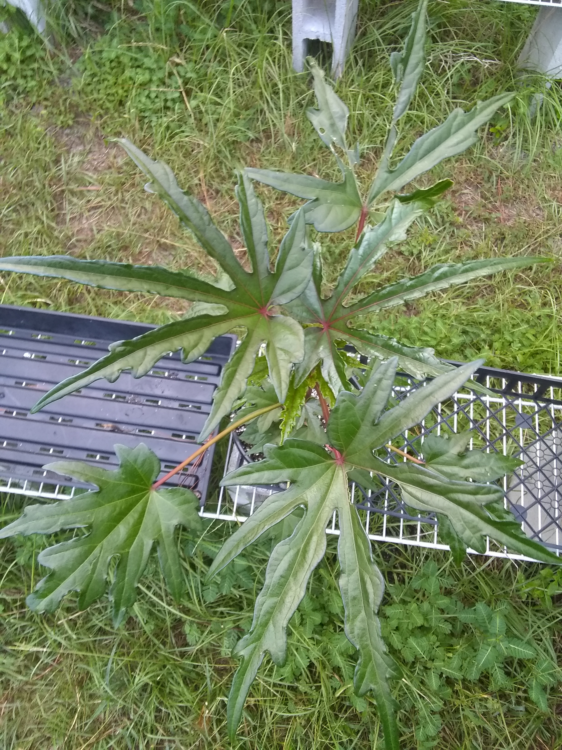 |
Abelmoschus manihot ‘Chief Kubo’s Prize’ – South Sea Salad Tree |
Ok, folks I have just found out the best information ever on this tropical cousin of Okra. Yes the leaves and stems and immature seed pods are edible and so are the flowers, but it is apparently perennial in zone 8A. Sopme sources say 8B, but the USDA states 8A and really who are you going to believe, some random website or these folks!
https://pfaf.org/User/Plant.aspx?LatinName=Abelmoschus+manihot
https://plants.ces.ncsu.edu/plants/abelmoschus-manihot/
 |
Hibiscus coccineus ‘Texas Star’ - Scarlet Rose Mallow |
Yup, this is the plant that had a neighbor calling the police on me because she was absolutely certain it was marijuana, and the leaves do look that way, until it flowers.
 |
Ricinus communis ‘Zanzibar’ – Castor Bean |
It keeps getting bigger, it's literally just a little bit shorter than the dogwood behind it and all this growth in a single growing year. Let's hope it can survive the winter.
 |
Rosa ‘oregold’ – Oregold Rose |
I've said it before and I'll say it again, I am not a fan of roses in general, and only three specimens are allowed int he test gardens because of their exceptional health and vigor. The golden yellow of this one is remarkable.
 |
Hosta sp. - Hosta |
This is one of the more colorful hostas that was recovered from the crescent bed earlier in the year, it has tripled in size and for the first time it's going to bloom. Not long after taking this picture it was repotted to a much larger 15 gallon pot. Oh and don't mind the feisty kitten photobomb.
 |
So, while
the temperatures and humidity have been low I decided to dig out all the Daylilies that aren’t
really doing good. I replaced them with the Texas Star Hibiscus, Mekong Giant
Banana, Bear’s Breeches and the South Sea Salad Tree. The lilies have been moved to the large strawberry pot after the strawberries were removed. Like the lilies the Strawberries have been progressively under performing for a while.
|
 |
| Would you look at that, the hot sauce made from my Fayetteville Inferno Peppers is right there on the Board at Fowler's BBQ! |
Here are the latest YouTube videos for your garden entertainment:
Salad Tree? Not in here buddy! (100th LITFM!)
https://www.youtube.com/watch?v=SP1r_yoXN2c
I’d make a meat pun here but it’d get butchered.
https://www.youtube.com/watch?v=jyYjbtziznM
Go for the Gold-enrod!
https://www.youtube.com/watch?v=Rus8Tz5sRlg
So many breeches I can’t bear it
https://www.youtube.com/watch?v=61ubssXhFms
Spring will be here in a lily bit
https://www.youtube.com/watch?v=eS_h8sMMYb4
With all that garden goodness covered this is the part of the blog where I have to advertise for the Fayetteville City Market. Now I know you readers probably don’t much like advertisements, but by booth at the City Market helps to cover the costs of running the test garden and literally maintains the Research & Development budget that is used to bring you the information that has made up the backbone of this blog. Also, as of the start of 2019, my booth can now process credit or debit cards thanks to the acquisition of s a Square reader so your payment options have doubled. With that said, if you want to get some GMO-free, Organic fruit, herbs, flowers and perennials, come on down to the Fayetteville City Market on 325 Maxwell Street in downtown Fayetteville between the Hours of 9:00 am and 1:00 pm on Saturdays. Even in bad weather the market goes on though you might have to look for me under the ‘arches’ of the Transportation Museum’s front entryway.
Fresh Produce:
Fresh Garlic: $1.00 (Available now!)
Soup Kits: $6.00 (Available in October)
Vegetables: ($3.00 each)
Arugula, Astro
Broccoli, Green Magic
Cauliflower, Snow Crown
Collards, Green Glaze
Endive, Benefine
Kale, Dinosaur
Kale, Red Russian
Kale, Redbor
Kale, Dwarf Blue Curled
Spinach, Green Beret
Herbs: ($3.00 each)
Cat Mint
Parsley
Oregano
Fruiting Plants:
Muscadine Grapes, Green ($4.00)
Ornamental Stuff: ($3.00 each)
Coneflower, Artisan Soft Orange ($3.00)
Coming Soon:
TBA
How to stay in Contact with Us!
Our group’s online presence has migrated to Nextdoor.com. All you need to keep up with all our activities is to have a Nextdoor account and to look for the ‘Sustainable Neighbors of Fayetteville’ group and ask to join! You don’t have to live in Fayetteville to join us! Feel free to ask all your garden questions of our knowledgeable membership and post your cool garden pictures.
https://nextdoor.com/g/ybvdm226x/?is=nav_bar
Meetings are back on track folks! We now meet at LeClairs General Store on the First and third Thursday of every month. Our next meeting is on October 7th between 5:30pm and 7:00pm. We are in the back room so come on in and join us for a fun garden chat.
If the two above methods do not work you can always contact me through this blog, PM me through Nextdoor.com and or visit the Fayetteville City Market. This brings to a close the eighteenth LITFM post of 2021; stay tuned the next episode which should be posted at some point in October. There will be more garden updates and other cool stuff.


