Today we’re going to move on from the Carrot Family to the Cabbage family which is scientifically known as Brassicaceae but in older publications you will find the family listed as the Cruciferae. The older name Cruciferae has quite a history, it stems from the Latin word ‘Crucifer’ which means cross-bearing. This has to specifically do with an old world species of Mustard which had its four flower petals arranged in a cross like shape. The new name Brassicaceae was proposed in the 1830’s and the slow shift to using the new name tool until the early 20th century so 1901 to perhaps 1930. Older gardening books from the 1960’s or 1980’s may still refer to the family as the Crucifers or Cruciferae. It is also not uncommon to see members of the family called Cruciferous Vegetables or Cole crops. The term ‘Cole’ derives from the Latin word Caulis, which means ‘stem’ or ‘stalk’, which fits when you’re looking at Marrow stem Kale, or Brussels Sprouts and a few other cultivated varieties. Beyond this, the Cabbage family is very diverse; there are over three-hundred and fifty genera in the family meaning that you could have encountered one and not have known it. Additionally, the family is so wide-spread that you can find a member of the family on almost every continent. The sole noted exception is of course Antarctica and certain areas of the tropics such as parts of Brazil, the Congo Basin and parts of Pacific Asia. Otherwise if you garden eventually you’re eventually going to grow a member of this very diverse family. It is generally held that most if not all members of the cabbage family are helped by proximity to herbs such as Hyssop, Thyme, Wormwood, Chamomile, Dill, Sage and, Rosemary. Also as noted with the last to postings they benefit from being near Celery, Onions and Potatoes. Most members of the cabbage family are heavy feeders so they will need compost or fertilizer added to the soil every year. Cabbage due to its nature as a heavy feeder for example can deplete a soil of Nitrogen potassium and phosphorous in as little as 70 to 100 days. The depletion can be devastating if you grow this crop in the same spot year after year but don’t do anything for the soil. Typically this is where compost or large amounts of composted animal manure comes in. Natural mineral based fertilizers can help with this problem also while artificial (ew!) fertilizers that are water soluble can act as stopgaps during an active growing season.
 |
| Mature Arugula looks a bit different then store bought and tastes way better than store bought. |
Arugula (Eruca sativa) – In addition to what is noted above, Arugula is specifically noted to do best in growing in the light shade of another plant. In the south east this means also that it cannot handle summer heat for long before bolting.
 |
| Until the flowers emerge Broccoli looks like Collards or any number of other similar Cabbage Family members, thankfully the leaves are tender and need no frost to 'sweeten'. |
Broccoli (Brassica olceracea. variety italica) – Broccoli is essentially a Cabbage bred to produce a large flower head instead of leaves. Companions for Broccoli are the aromatic Herbs such as Rosemary, Camomile, Thyme, Sage or Dill. Garlic or any other member of the Onion family is a good companion and may help fend of pests. Annual Flowers such as Marigolds or Nasturtiums and short season crops like Lettuce, Carrots, Swiss Chard, Beets, Spinach and Radishes are good too.
Brussels Sprouts (B.o. var. gemmifera) – Since Brussels Sprouts are essentially just cabbage that has been selected to focus on large side buds. (See broccoli companions)
Cabbage (B.o. var. capitata) – Cabbage comes in a few forms such as the usual round Green, Red, crinkly Savoy, the Asian types and the pointed types such as Apex. Cabbage is a heavy feeder that can deplete the soil if crop rotation is not used and it is quite vulnerable to foliar disease and Cabbage Moth Larva. (See broccoli companions)
Cauliflower (B.o. var. botrytis) – Cauliflower operates the same way as Broccoli, albeit Cauliflower has somehow obtained a college education.
 |
| I typically grow collards in lieu of traditional cabbage because they do not deplete the soil a badly. |
Collards (B.o. var. viridis) – Collards are very interesting; they used to be called Colewort because they were a cabbage crop that did not form a head. In a nutshell a collard is a super-loose leaf cabbage, and you can really see it in the Cabbage-Collard cross. Thankfully Collards don’t rapidly deplete the soil like Cabbage does and it can easily survive defoliation by Cabbage Moth larva. Collards much like Kale are ancient primitive forms of Cabbage. Collards follow the same companion planting rules as with Broccoli, but I’ve found that they don’t mind Chicory being grown under and in between them.
Cress, Garden (Lepidium sativum) – Garden Cress is an annual that is fast growing and pairs well with the Onion Family and other leafy greens. It is considered a cool-season annual so plant in spring and fall.
Cress, Upland (Barbarea verna) – Upland Cress is also known as ‘Creasy Greens’, it’s typically used as a trap crop at the end of plantings of other Cabbage family plants to act as a trap crop for pests. It is perfectly edible on its own and makes for a respectable microgreen.
Cress, Water (Nasturtium officinale) – Water Cress is often confused with the flowering annual also called Nasturtiums but they are not related. This member of the cabbage family as its name suggests loves being near water or being moist. It pairs well with Lettuce, Parsley and Celery but is said to match up with Mint. It is considered invasive in most of the USA except for North Dakota, so keep it in a pot.
Horseradish (Armoracia rusticana) – Horseradish is known to repel Blister beetles and this makes it an excellent match for White Potatoes. There is some disagreement on if it repels Potato Beetles or not but it is clearly noted that it should be planted at the corners of the Potato plot and be dug yearly so the Horseradish does not spread and take over.
 |
| This type of Kale has a dozen common names but I prefer Dinosaur Kale, the specific variety is 'Black Magic'. |
Kale (B.o. var. sabellica) – Kale is a generally a cool season annual crop despite being a biennial. It will survive our winters, maybe. (See broccoli companions)
Kohlrabi (B.o. Gongylodes Group) – Kohlrabi is basically a cabbage that makes moderate sized leaves but is valued for its swollen stem that can be as large as a softball. (See broccoli companions)
Moringa Tree (Moringa oleifera) – Moringa, is noted to be a top-tier companion plant because it has a deep taproot and has the ability to fix nitrogen in the soil. All parts of this plant are useful for food and medicinal/Herbal purposes so it’s one of the best things you can grow. It is not hardy in the ground in our zone but if it is grown a large pot and brought in for the winter you can have one. It pairs well with herbs, marigolds, smaller leaf greens and sweet potatoes.
 |
| The Mustard is in the upper right and on the upper left. (Upper left) Japanese Red Giant Mustard, (Upper right) Purple 'Miz America' Mizuna Mustard. |
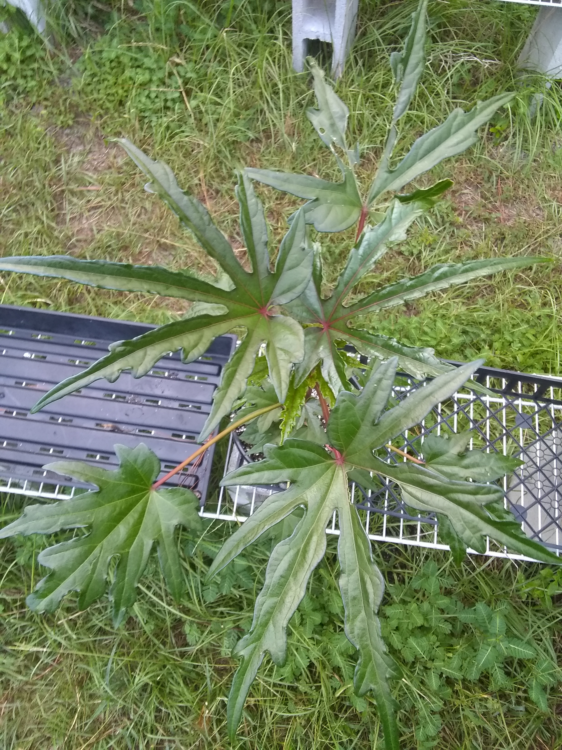
Mustard, Greens (Brassica juncea) – Mustard Greens are typically found at the supermarket in the form of bright green somewhat crinkly leaves. Mustard Greens pair well with carrots, Radishes and the same plants that Broccoli does. They are less susceptible to Cabbage Moths if any other member of the Cabbage family is present.
Mustard, Seed (Brassica nigra) – Mustard seed as a companion plant follows the same rules as a lot of the rest of the Cabbage family, but also does well next to the herb Yarrow. It also gains benefit from the shade cast by rows of corn.
Radish (Raphanus sativus) – Radish are one of the fastest crop plants possible; some varieties are mature and ready to harvest. Cherry Belle is so fast that it is ready in about 20 growing days from seed. Radishes benefit from proximity to Mustard Greens and Nasturtiums and also seem to grow well around Red Root Pigweed (Amaranthus retroflexus) which is edible. Radishes are said to repel Striped Cucumber Beetle so it is a good companion for Cucumbers Squash and melons.
Rapeseed/Canola (Brassica napus) – Rapeseed is a strange name; it has nothing to do with ‘S.A.’ however. In this case the name comes from the Latin word Rapa, which means Turnip so Rapeseed is just Turnip Seed. This seed crop plant needs ground covers such as clover, vetch or buckwheat to suppress weeds and feed the soil so it can grow to maturity. Its primary pest is the Pollen Beetle, though Flea beetles, Cabbage Seed Weevils, Brassica Pod Midge and Aphids are problems. If you are determined to grow this one, you might have to use organic pesticides.
Rutabagas (Brassica napus Napobrassica Group) –
Silver Dollar Plant (Lunnaria annua) – Silver Dollar plant is a common sight in seed racks at garden centers this time of year. It is a biennial with edible leaves that produces foliage the first year then pretty purple flowers the second year followed by large silvery seed capsules that are flat and the size of a Silver Dollar. This biennial doesn’t have much in the way of information for companion plants, and most of that are just plants that grow in the same conditions such as Foxglove, Ferns and Lady’s Mantle.
Turnips (Brassica rapa subspecies rapa) – As a general rule, you for the most part should not plant cabbage family members near legumes. Turnips are the exception to the rule as they benefit from that and the presence of the aromatic herbs such as Rosemary, Garlic, Thyme and Sage.
Wasabi (Eurema japonicum) – Wasabi is one of those plants where the companion matchups aren’t about plants providing mutual aid and are about other plants that share it’s growing preferences. The three most common suggestions are Hostas, Ginger and Ferns.
In regards to the cabbage family it would be a terrible oversight not to talk in more detail about the pests that can wreck your crops. Due to our climate and long growing season, there are at least five species of Butterfly/Moth whose caterpillars can make your crop unsaleable. The first species is just called a Cabbage Moth (Mamestra brassicae). But also there is the Large White Cabbage Butterfly (Pieris brassicae) which closely related to the Small White Cabbage Butterfly (Pieris rapae), also The Cabbage Looper (Trichoplusia ni) and last the one I haven’t seen the Cross-Striped Cabbage worm (Evergestis rimosalis). There are three ways to deal with these critters; the first is hand picking once you start seeing the adults fluttering about because the adults home in on the chemical compounds exhaled by your crop when they exchange gasses. Companion planting can help mask this but inevitably as Steve Goldblum’s character said in Jurassic Park ‘Nature..uh, finds a way.’ Adults flying about mean that there are probably eggs and as such, hungry caterpillars will follow soon after. Handpicking the caterpillars is easy when you have a few plants but fifty foot rows of crinkly kale makes that kind of difficult. So that’s where the organic pesticides come in, you could make one out of tobacco or a few other plants or use Neem Oil. The catch is that all of these are contact based and wash off in the rain. So you have to coat every possible surface to ensure that the batch of wrigglers is knocked down and kept in check. Alternately, and I do not prefer this method you can treat your crop with a 30-60 day systemic pesticide, but you need to be careful of which one you use, it’s residual action and be careful that there are no unintended effects. Lastly and this is my least favorite option; conventional Insecticide. Of the insecticides out there, I prefer pyrethrum-based insecticidal soap because it’s effective, has no real residual action and is inexpensive. However there are others that get stronger and have longer action but, those too have problems because they may be restricted to purchase, require personal protective gear and some damage native and honey bee populations (ie Malathion). Either way, I’d rather be with good options than without so plan carefully and see you next time for the Onion Family.